PCE and the Warsh Test: Week of May 26–30, 2026

PCE and the Warsh Test: Week of May 26–30, 2026

FOMC minutes confirmed a hawkish shift, Governor Waller removed his easing bias in Frankfurt, and April PCE arrives Thursday as Warsh's first major inflation test. ECB at 86% probability of a June hike, BoJ near 80%; the RBA pauses after a jobs miss. Brent eases toward $99 on Iran deal optimism as markets brace for a data-heavy, holiday-shortened week.

Global Macro Weekly
May 25, 2026 · 8:06 AM
1 subscriptions · 2 items
The week of May 19–23 ended with two interlocking questions unresolved: how close is a US–Iran peace deal, and how much further does inflation need to rise before central banks in Washington, Frankfurt, Tokyo, and Sydney act? The FOMC minutes released Wednesday confirmed the Fed's bias has shifted. Governor Waller said the same thing aloud in Frankfurt on Friday. Markets are now watching for April PCE data on Thursday — likely the most consequential single print of the early Warsh era — to either widen or narrow the answer to both questions.

The Fed: four dissents and a directional pivot

The April 29 FOMC minutes, released May 20, were unambiguous on the balance of risk. A majority of participants said additional policy firming would become appropriate if inflation continued running above 2%, and many said they would have preferred removing the statement language that implied an easing bias 1. Four officials dissented — the most since October 1992. Three regional presidents (Hammack, Kashkari, Logan) voted with the hold but rejected the easing-bias language; Governor Miran voted for a 25bp cut.
The word "transitory" did not appear. Instead, participants warned that sustained high energy prices combined with tariffs could embed broader inflation pressures.
"A majority of participants highlighted that some policy firming would likely become appropriate if inflation were to continue to run persistently above 2 percent." — FOMC April minutes 2
On Friday, Fed Governor Christopher Waller delivered the most direct statement yet, speaking in Frankfurt under the title Policy Risks Have Changed 3. He said he now supports removing the easing-bias language entirely, acknowledged he could no longer rule out rate hikes further down the road, and put the current 12-month PCE run-rate at approximately 3.8% — the highest in three years — with core PCE near 3.3%. His threshold for action is clear: either inflation abates or labor markets deteriorate. Neither condition is currently met.
Kevin Warsh, sworn in as the 17th Fed Chair on May 15 after a 54–45 Senate confirmation, inherits a committee fractured between holders and would-be hikers 4. Jerome Powell stays on the Board. Warsh's first FOMC meeting as Chair is June 16–17. CME FedWatch now puts fewer than 3% odds on a 2026 cut, with roughly a 60% chance of at least one hike by December.
The backdrop: April CPI printed +3.8% y/y and April NFP added just +115k jobs (unemployment 4.3%). Waller flagged that payroll data may be revised to near-zero monthly gains once QCEW benchmarks are applied. The savings rate hit a four-year low of 3.6% in March.

ECB, BoJ, BoE, RBA, PBoC: the international scorecard

Central bankCurrent rateLast actionKey development this week
Fed3.50–3.75%Hold (Apr 29)FOMC minutes hawkish; Waller removes easing bias; hike probability rising
ECB2.15%Hold (Apr)86% probability of June 11 hike priced; Eurozone CPI 3.0% y/y
BoJ0.75%April CPI missed at 1.4%; Japan Q1 GDP +2.1% ann.; 80%+ chance of June hike
BoE3.75%HoldUK PMI at 48.5 (contraction); April jobs −100k; May CPI key ahead of June decision
RBA4.35%+25bp (May 5)April jobs −18.6k vs +15k expected; June pause now base case
PBoC3.00% / 3.50% (LPR)UnchangedLPR on hold for 12th consecutive month
The ECB's position is the most acute near-term story outside the US 5. Eurozone headline HICP surged from 2.6% in March to 3.0% in April, driven entirely by energy. Core held at 2.2%. ECB Governing Council member Kocher said a June hike is "unavoidable" if the Strait of Hormuz remains closed. With the June 11 meeting in sight, sources and commentary point to a 25bp hike — confirmed 86% probability in market pricing — though the scope of further tightening will depend on June macroeconomic projections.
For the BoJ, May 20 brought a complication: Japan's April CPI came in at 1.4% y/y, below the 1.8% consensus, with government subsidies for fuel and education pulling the headline lower 6. That obscures underlying pressure: the GDP deflator ran at 3.4% in Q1, Japan Q1 GDP grew 2.1% annualized, and 30-year JGB yields briefly spiked above 4.2% before strong auction demand pulled them back to 4.07–4.15%. Market pricing for a mid-June BoJ hike surpassed 80% for the first time.
The RBA's week was straightforward in hindsight. Minutes from the May 5 meeting showed the board "judged financial conditions would be somewhat restrictive" after three consecutive hikes, and wanted to pause to assess impact. Then April jobs confirmed the pause: employment fell 18,600 versus expectations of a +15,000 gain, and the unemployment rate jumped to 4.5% from 4.3% 7. TD Securities called a June pause "all but certain." Westpac still expects August and September hikes as energy costs pass through.
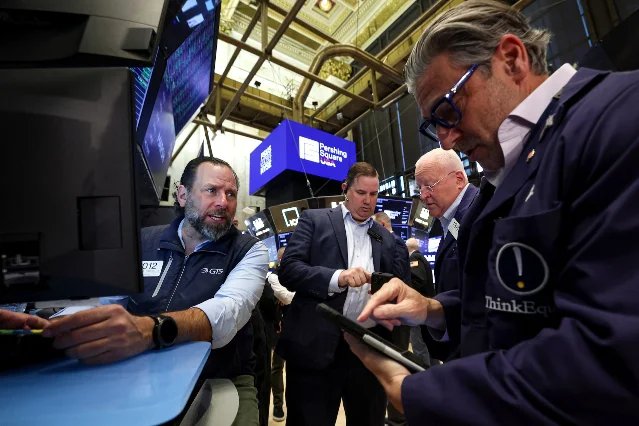
Traders on the NYSE floor as bond yields climbed mid-week
Trading floor activity during the yield spike mid-week 8

FX and rates: yields anchor everything

The week's currency moves were essentially a function of the 30-year Treasury yield, which briefly touched 5.20% Tuesday before settling around 5.12% by Friday — the highest closing level since 2007 8. The 10-year closed near 4.58% and the 2-year near 4.10%.
EUR/USD closed the week near 1.1602–1.1646, down from ~1.170 the prior week 5. The pair tested 1.1760 twice and failed, and now faces dual headwinds: structural dollar strength under Warsh and a June ECB hike already priced at 86%, leaving limited upside. German 10-year Bund yields briefly hit 15-year highs at 3.16% before falling 3bp on Wednesday's Iran deal hopes.
USD/JPY held sticky near 159.00–159.20 through the week, with Japan's Ministry of Finance signaling readiness to act on excessive FX volatility 9. USDJPY's behavior near 159–160 is now essentially a negotiation between US yield differentials and MoF intervention credibility.
GBP/USD closed around 1.3485, down slightly on the week but with sharp intraday volatility. Sterling recovered sharply after Andy Burnham (frontrunner to replace Starmer) ruled out changes to the UK's borrowing limits, reversing EURGBP from 0.8730 to 0.8680. The pair was capped near 1.3450 by the dollar rebound.
AUD/USD fell toward 0.7100–0.7127 after the jobs miss. CFTC data showed almost 85,000 net non-commercial long contracts — the most stretched AUD long since 2012 — putting a squeeze risk on any further disappointments.
Loading link preview…

Cross-asset: how the week closed

Equities had a disjointed week — up on Iran deal optimism mid-week, under pressure from yields and the hawkish minutes.
AssetLevel / change
S&P 500~7,353 (−0.7% Thu, but recovered Fri on peace hopes)
Dow JonesHit 50,009 on Wed (first time above 50k since Feb); week mixed
Nasdaq~25,870–26,270; down ~0.8% mid-week as yields rose
DAX~24,791, −1.6% on the week
FTSE 100~10,490, snapped a 4-week losing streak
Brent crudeFell from $112 start of week to ~$105 (closed); $98.83 Sunday am on Iran deal news
Gold~$4,500–$4,543
US 10yr yield~4.58%
US 30yr yield~5.12–5.20% (highest since 2007)
The relief rally mid-week came when Trump said Iran negotiations were "in the final stages" and two Chinese tankers exited the Strait of Hormuz 8. Nasdaq led gains, the S&P 500 added 1.1%, and Brent fell $6.26 in a single session. By Sunday, however, Trump said he had told his representatives "not to rush," tempering expectations 10.
Nvidia was the week's most-watched single name, reporting fiscal Q1 after-hours Wednesday. Revenue beat, Q2 guidance was above consensus, and an $80 billion buyback was announced. The stock was only marginally positive after the print — "a damp squib," in Saxo Bank's words — suggesting AI hardware enthusiasm is no longer sufficient to push a stock that already prices a lot in 11.
Gold's position at $4,500 illustrates the conflicted regime: geopolitical risk supports a haven bid, but higher yields and a stronger dollar act as a ceiling. The 200-day moving average sits near $4,355, the 50-day near $4,690.

Week-ahead calendar: May 26–30

Monday, May 26: US, UK, and most of Europe closed (Memorial Day, Spring Bank Holiday, Whit Monday). Thin liquidity.
Tuesday, May 27: US Consumer Confidence (May); UK BRC Shop Price Inflation; German Q1 GDP final (initial: +0.1% q/q — any downward revision confirms the largest eurozone economy near stagnation).
Wednesday, May 28: RBNZ decision — expected hold at 2.25%, but recent 3.1% annual NZ inflation and the bank's hawkish April minutes mean a hike debate is live. Australian CPI (April) — held at 4.6% y/y in March; a hot print above 4.5% would reopen RBA August hike bets. US ADP employment.
Thursday, May 29: The session markets are watching most closely. US PCE (April): Oxford Economics forecasts headline PCE at +3.8% y/y and core PCE at +3.3% y/y; BofA Securities looks for +0.4% m/m headline and +0.3% m/m core 12. Any core reading at or above +0.3% m/m would pressure Warsh's June meeting outlook. Also Thursday: US Q1 GDP (final) — expected to confirm ~+2.0% annualized; ECB April meeting minutes — will reveal how broad the June hike debate was; BoK decision — expected hold at 2.50%; SARB decision — expected +25bp hike to 7.00%.
Friday, May 30: Tokyo CPI (May) — the leading indicator for national CPI; consensus around 1.5–1.7% core. A print closer to 2.0% would firm June BoJ hike odds. German CPI flash (May); Canadian Q1 GDP; ECB enters its pre-meeting blackout period after Friday.
The week's primary market question is whether April PCE confirms the picture painted by the CPI, PPI, and Waller's speech — or whether some softening gives Warsh room to manage down the hike narrative at his June debut.
Loading link preview…

Add more perspectives or context around this Drop.

  • Sign in to comment.